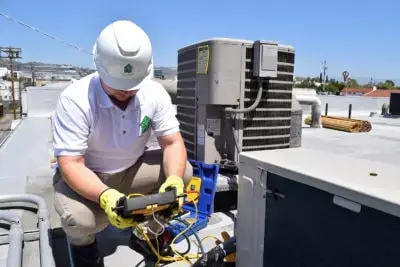
Navigating AC replacement cost in Los Angeles requires more than just looking up equipment prices online. With microclimates ranging from the hot San Fernando Valley to the marine exposure of Santa Monica, your home needs a tailored cooling strategy. Home Upgrade Specialist (CSLB #1031989 / #1055444) helps Los Angeles homeowners compare system options, ductwork conditions, permit needs and practical cost factors before choosing an AC replacement or heat pump upgrade. For the full installation process, review our main AC installation in Los Angeles guide and the broader HVAC services in Los Angeles hub.
Before diving into Los Angeles AC replacement costs, you must decide if replacement is actually necessary. While our technicians can repair most failing components, there comes a tipping point where pouring money into an aging system is a poor financial decision.
One useful guideline is the $5,000 Rule. Multiply the age of your air conditioning unit by the estimated cost of the repair. If the total exceeds $5,000, replacement may deserve serious consideration, especially when comfort issues, refrigerant type, repeated repairs, efficiency, warranty status and upcoming code requirements are also part of the decision. For instance, a $600 repair on a 10-year-old system equals $6,000, which is a strong signal to compare repair and replacement carefully.
Additionally, if your current AC relies on R-22 refrigerant, repairing a refrigerant leak has become prohibitively expensive. In 2026, replacement planning should also account for current refrigerant rules, manufacturer availability, equipment matchups, and whether the better path is a like-for-like AC replacement or a heat pump system that handles both cooling and heating.
The largest single factor driving your AC replacement cost is the tonnage (the cooling capacity) of the equipment. The table below maps common system sizes to typical home sizes. Exact equipment and pricing are confirmed after an assessment of your home. These categories explain how scope changes from one home to another.
*A typical AC replacement scope includes equipment, labor, refrigerant, electrical connections, basic ductwork modifications, LADBS/city permits, and final inspection. It usually excludes major duct replacement, full electrical panel upgrades, or asbestos abatement.
One of the most frequent mistakes made by budget contractors is relying solely on square footage to size an air conditioner. The old industry rule of thumb—1 ton per 500-600 square feet—is incredibly inaccurate for Southern California.
A 2,000 square-foot home in Woodland Hills facing west with original single-pane windows will require vastly more cooling power than a 2,000 square-foot home in coastal Manhattan Beach tucked beneath mature shade trees. This is why Home Upgrade Specialist performs a comprehensive Manual J Load Calculation during every assessment. We evaluate insulation levels, ceiling height, window placement, and local microclimates. Installing an oversized AC unit will cause "short-cycling"—cooling the house too rapidly without removing humidity, leaving you cold and clammy while significantly shortening the lifespan of your compressor.
Not all cooling systems are created equal. The brand you select affects upfront cost, warranty, noise levels, and long-term energy use. The comparison below is shown for a standard 3-ton system to compare tiers, efficiency, and warranties:
Understanding SEER2: The higher the Seasonal Energy Efficiency Ratio (SEER2), the less electricity the system consumes. While premium brands with variable-speed compressors carry a higher upfront cost, they can reduce cooling energy use over their lifespan, though savings vary. Variable-speed technology adjusts seamlessly to maintain exact temperatures, unlike older single-stage systems that blast at 100% capacity before shutting completely off.
If you are reading this guide because your air conditioner is failing, stop and consider the heat pump alternative. You essentially have two paths for upgrading:
Let's see a general comparison of the two paths (not based on a specific customer):
In this example only (subject to scope and eligibility), the economics of a heat pump can differ from a like-for-like AC replacement. Heat pumps move heat efficiently and can lower heating energy use compared with gas; actual savings depend on home, rates, equipment, and usage.
Beyond tonnage and brand, the structural realities of your Los Angeles home dictate final pricing. The base price can fluctuate based on the following specific requirements:
Connecting a high-efficiency AC to leaky, 40-year-old ducts is like putting a Ferrari engine in a tractor. Old or unsealed ducts waste up to 30% of your cooling. Sealing, repairing, or replacing bad ductwork adds cost based on project scope.
Older LA homes (built pre-1985) often run on 100-amp panels. Upgrading to a powerful variable-speed system or heat pump may require an electrical panel upgrade. If necessary, a panel upgrade adds cost based on project scope.
Homes near the ocean (Santa Monica, Malibu, Manhattan Beach) are highly susceptible to salt-air corrosion. We strongly recommend coastal-rated equipment treated with specialized marine-grade coatings, which adds a premium based on project scope to ensure longevity.
California Title 24 compliance is strict. Tonnage changes or duct alterations mandate third-party HERS testing to verify efficiency, along with LADBS city permits. This adds cost based on project scope and helps confirm your installation meets strict legal and safety codes.
When your AC fails during a heatwave in August, waiting weeks is not an option. Home Upgrade Specialist prioritizes rapid, communicative turnarounds. Project timelines vary based on permitting, equipment availability, inspection scheduling, ductwork, electrical scope, access and season. For a full walkthrough of what to expect, see our AC installation guide for Los Angeles homeowners.
The timeline breaks down as follows: We spend 3 to 5 days pulling the necessary LADBS or local city permits. Once approved, our crews arrive for a 1-to-2-day physical installation. We protect your floors, handle all demolition and removal of your old system, set the new condenser and coil, establish the electrical and refrigerant lines, and perform a full system startup. Finally, we schedule the city inspector for final sign-off to ensure everything is strictly up to code.
Note: During peak Southern California cooling seasons (June through August), equipment supply chain lead times can occasionally push timelines to 2-3 weeks. We recommend proactive assessments before the extreme heat arrives.
A fair AC installation price reflects the full scope, not just the equipment box. For a like-for-like central AC replacement, a complete LA install typically includes the condenser and coil, refrigerant, electrical connections, basic duct modifications, LADBS/city permits, Title 24 HERS testing where required, and final inspection — the tables above show how tonnage, brand tier, ductwork and electrical scope move the number. The best way to judge whether a quote is fair is to compare written scopes line by line: confirm a Manual J load calculation was done (not just square footage), that permits and HERS testing are included, and that equipment model numbers and warranty are spelled out. We confirm your exact price in a written estimate after an assessment — see our AC installation guide or start an HVAC estimate.
AC replacement cost in Los Angeles depends on tonnage, system type, brand, ductwork condition, electrical needs, and permits. A heat pump can replace both your AC and furnace and may qualify for incentive programs that a like-for-like AC swap does not. We confirm pricing and eligibility in a written estimate after an assessment.
Industry rule of thumb is 1 ton per 500-600 sq ft for LA homes, but this varies significantly by insulation, window count, and microclimate. A proper Manual J load calculation (included with HUS estimates) is the right way to size it correctly. Oversized ACs short-cycle, leading to humidity problems and shortened equipment life.
Sometimes, depending on the home and current non-federal program rules. A heat pump can replace both your AC and furnace and may qualify for utility, state or manufacturer programs that a like-for-like AC swap does not. The federal Section 25C credit is not available for property placed in service after December 31, 2025. Eligibility, funding, equipment requirements and timing must be confirmed during your estimate.
AC installation timelines vary by permitting, equipment availability, inspection scheduling, scope, ductwork, electrical needs and season. A straightforward replacement may move faster than a project requiring duct repairs, panel work, crane access or special-order equipment.
Don't guess on sizing or pricing. Every estimate includes a Manual J load calculation and a review of the incentive programs you may qualify for. Home Upgrade Specialist is fully licensed (CSLB #1031989 / #1055444), serving Los Angeles and Southern California.
HOME UPGRADE SPECIALIST
Compare heating and cooling options for your home.
