
On this page
Direct answer: when Tesla Solar Roof makes sense in Los Angeles
Tesla stopped public Solar Roof sales in August 2026. For current transition guidance, existing-owner information and previously approved projects, start with the primary Tesla Solar Roof transition page for Los Angeles. Use the supporting 2026 Solar Roof cost/status guide for historical pricing factors and product comparisons. For a new Tesla energy project, compare Tesla Solar Panels + Powerwall and a solar-ready roof when replacement is needed. This guide remains useful for understanding how Powerwall planning relates to existing or previously approved Solar Roof systems.
That difference matters most on homes with visible front-facing rooflines, custom architecture, hillside locations, HOA appearance concerns, or major exterior remodel plans. It can also be a strong fit when homeowners want roofing, solar, battery storage, and electrical upgrades reviewed together instead of treated as separate projects.
Home Upgrade Specialist helps homeowners compare Solar Roof, roof replacement, traditional panels, Powerwall sizing, utility planning, and electrical scope before a contract is signed. Solar, roofing, and battery work is performed under CSLB #1055444, and the company is a Tesla Certified Premium Installer. For project-specific planning, call (833) 446-6387 or request a free estimate.
Quick fit checklist before you request a proposal
Before choosing Solar Roof over standard solar panels, review the factors that usually shape the decision:
- Roof age: Solar Roof often makes more sense when roof replacement is needed now or within the next few years.
- Design goals: Integrated appearance may matter more on highly visible roof planes or architecturally important homes.
- Electrical scope: Main panel capacity, EV charging, HVAC electrification, and battery count should be reviewed early.
- Utility territory: LADWP and SCE customers should compare current interconnection rules, billing structure, and battery strategy.
- Incentives: SGIP, financing terms, and any local programs should be verified under current rules before assumptions are made.
- Timing: Roof tear-off, underlayment, tile installation, inspection, and permission to operate should be planned as one project.
A practical way to use this list is to score each item honestly. A homeowner with a 20-plus-year-old roof, strong curb appeal concerns, and plans for EV charging and battery backup will usually evaluate Solar Roof differently than a homeowner with a newer roof and a simple bill-reduction goal. Helpful resources include the roof replacement before solar guide and the Powerwall sizing guide.
Key takeaways for homeowners comparing roof and battery options
Integrated roof and solar
Tesla Solar Roof replaces roofing material and generates electricity in the same system.
Best when roof timing aligns
It is often a stronger fit when the home already needs a new roof or major remodel work.
Powerwall planning matters
Battery count, backed-up loads, Gateway location, and outage expectations should be defined early.
Coordination is essential
Roofing, solar, battery, permits, inspections, and utility approval should be managed together.
For many Southern California households, the real question is not whether solar is useful. It is which solar path fits the property best. A newer roof with wide unshaded planes may point toward conventional panels. Historically, a high-value home with an aging roof and strong aesthetic priorities was a common Solar Roof use case. For a new project today, compare a premium solar-ready roof with current solar panels and Powerwall instead.
How Tesla Solar Roof works and what to review in design
Solar Roof should be evaluated as a complete building and energy system, not just a solar product. The roof includes active and inactive tiles. Active tiles generate power. Inactive tiles complete the roof appearance and weather protection. Production depends on usable roof planes, pitch, orientation, shade, vent placement, and how much surface area is available for active tile layout.
A strong proposal should identify where active tiles will be installed, expected annual production, inverter placement, and access for future service. It should also explain warranty categories based on the current Tesla documents provided for that project, including product, weatherization, and production terms where applicable.
A clear Solar Roof proposal should show active versus inactive tile layout, production assumptions, inverter placement, battery integration, and the path from roof work through final activation.
The inverter converts energy from the roof into electricity the home can use. Homeowners should ask practical questions: Where will the inverter be mounted? How will conduit be routed? Will monitoring use Wi-Fi or cellular connection? Can the existing service equipment support the proposed system? If a main panel upgrade is needed, that should be identified before final design is finalized.
Roof geometry matters. A simple roof plane with good sun exposure is usually easier to design efficiently than a complex roof with dormers, skylights, vents, and heavy shade. Homes in canyon areas or tree-lined neighborhoods may need especially careful shade review. For a fair comparison, many homeowners also review a Los Angeles solar panel installation proposal beside a reroof estimate and Solar Roof plan.
Tesla app monitoring and home energy management
The Tesla app helps homeowners track solar production, home usage, battery charge level, and reserve settings. For households comparing newer controls, the Tesla Home energy management guide explains how solar, Powerwall, EV charging, and rate-plan settings may work together. Monitoring is useful after permission to operate because daily performance changes with weather, season, charging habits, and evening loads.
- View real-time solar generation
- Track household energy use patterns
- Adjust backup reserve settings
- Monitor Powerwall charging and discharge behavior
- Receive alerts related to system status
Monitoring does not replace good design. Software cannot fix an undersized battery plan, unrealistic outage expectations, or a weak roof layout. App settings should reflect the homeowner's priorities. Some households want more stored energy reserved for outages. Others want to use more battery power during expensive evening utility periods.
Aesthetics, roof readiness, and when Solar Roof is the better fit
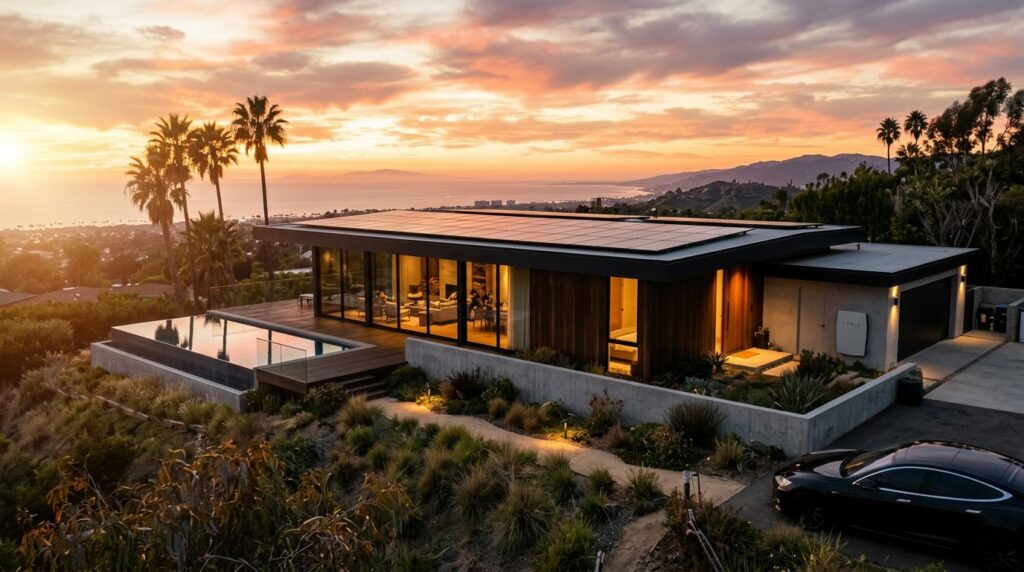
For many homeowners, the biggest appeal of Solar Roof is visual integration. Solar-producing tiles sit within the roof surface instead of above it. That can matter on custom homes, front-facing rooflines, hillside properties, and remodels where the roof is part of the home's architecture. For more on design priorities, see this guide to Tesla Solar Roof aesthetics and efficiency.
Appearance alone should not drive the choice. A good design must also address roof deck condition, underlayment, waterproofing, flashing, skylights, drainage, gutters, attic conditions, and code requirements. Older Los Angeles and Orange County homes may also need structural review or electrical updates before the project can move forward.
Homeowners should also define backup goals early. Whole-home backup, partial-home backup, and critical-load backup are different designs with different battery requirements. Related upgrades such as EV chargers, heat pumps, or service panel replacement should be reviewed before the roof layout is locked in.
The best Solar Roof design balances appearance, weather protection, production goals, electrical scope, and long-term service access.
A practical example helps. A visible remodel in the Hollywood Hills may lean toward Solar Roof because the appearance supports the architecture. A tract home in Orange County with a newer roof and favorable rear roof planes may reach the same energy goals more economically with traditional panels and a separate battery plan.
Need a site-specific Tesla Solar Roof and Powerwall review?
Compare roof condition, solar production, Powerwall 3 sizing, electrical upgrades, and utility planning before you sign. Call Home Upgrade Specialist at (833) 446-6387 or request a free estimate.
Request a Free EstimatePowerwall and Powerwall 3 planning for backup and NEM 3.0
Powerwall adds storage so some solar energy produced during the day can be used later. In Southern California, battery planning has become more important as homeowners compare NEM 3.0 solar payback, changing export values, and time-of-use rates. Batteries may support evening self-consumption, limited outage backup, and a more deliberate energy strategy.
Current Tesla Powerwall 3 specifications commonly reference 13.5 kWh of energy capacity, 11.5 kW continuous on-grid power, 11.5 kW continuous backup power, an integrated inverter and controller, and expansion capability. Those numbers are helpful, but final compatibility, equipment placement, wall space, and expansion options still need to be confirmed in the actual proposal. For budgeting, compare this page with the Tesla Powerwall cost Los Angeles 2026 guide before choosing battery count.
- Daytime storage: Solar energy can be saved for later use.
- Evening load shifting: Stored power may reduce grid use after sunset.
- Outage support: Selected backed-up circuits can continue operating during outages.
- Solar recharge: During suitable conditions, batteries may recharge from the roof.
Battery sizing should be reviewed step by step. Identify the loads that matter most, estimate how long they should run, decide whether large loads like air conditioning or pool equipment need backup, and compare that load profile with the number of batteries proposed. One of the most common misunderstandings is assuming one battery automatically means whole-home backup. It often does not.
Tesla Solar Roof vs a new roof plus traditional solar panels
Many homeowners are choosing between Solar Roof and conventional mounted panels. The better option depends on roof age, architecture, budget, energy target, and whether battery storage is included.
If budget is the main driver, compare Solar Roof against roof replacement plus traditional solar panels. If aesthetics, roof timing, and one coordinated installation matter just as much, Solar Roof may deserve the closer look.
Permits, inspections, LADWP and SCE planning, and next steps
Solar Roof installation is both a roofing project and an electrical project. Success depends on roof deck review, underlayment, flashing, tile layout, inverter location, battery planning, permit approval, inspection scheduling, and utility interconnection. Los Angeles County and Orange County homes may also involve local jurisdiction requirements that affect process and timing.
LADWP and SCE customers should verify current interconnection requirements, time-of-use structures, export compensation details, and battery strategy. SGIP and other incentives may also affect timing, but eligibility, funding, reservation status, documentation, and deadlines must be confirmed under current program rules before signing. Home Upgrade Specialist is not a tax advisor, and homeowners should review current tax guidance before assuming a federal credit outcome for 2026 projects.
Before requesting proposals, gather 12 months of utility usage, photos of the main electrical panel and meter, and a list of circuits you want backed up. Ask whether the project may require a panel upgrade, backup-load panel, or other electrical work. For additional planning, review LADWP solar and battery planning, Tesla Powerwall installation, and solar-ready roofing in Los Angeles.
If you want a clearer comparison of Tesla Solar Roof, Powerwall, roof replacement timing, and utility planning, call (833) 446-6387 or request a free estimate.
Frequently asked questions
What makes Tesla Solar Roof different from regular solar panels?
Tesla Solar Roof combines roofing material and solar generation in one integrated system. Standard panels are mounted above an existing roof.
Is it a good fit for every home?
No. It is often a better fit when roof replacement, appearance goals, and battery planning all line up.
Can Powerwall provide outage backup?
Yes, but performance depends on battery count, backed-up loads, solar availability, and final system design.
Do LADWP, SCE, NEM 3.0, and SGIP change the recommendation?
Yes. Utility rules and incentive eligibility can materially affect planning, so they should be reviewed for the specific property and current rules.
Plan your home energy project with one team
Compare scope, equipment and utility rules in a single written plan built around your address.
Start My Home Plan